
While traveling Route 66, we took the opportunity to discover an intriguing piece of American history tucked away in the woods outside Chicago. While camping at Camp Bullfrog Lake, we headed to Red Gate Woods to hike to Site A, the burial site of the world’s first nuclear reactor.
When we started the hike, I thought we were just hiking to a burial site, but the hike turned out to be a fascinating blend of nature, science, and history, with ties to the Manhattan Project and the dawn of the Atomic Age.
Hiking to Site A at Red Gate Woods
We arrived at our campsite and got everything set up. It was later in the day, and the sun would be setting soon, but I knew I wanted to do this short hike because who knows when I would be back in this area.
We grabbed a bottle of water and our geiger counter and set out. We didn’t even change clothes, lol; I was hiking in blue jeans! By my calculations it should only be about a 3-mile round trip on relatively flat land. I figured one hour of hiking with 30 minutes of sightseeing. We only had about 1.5-2 hours before sunset.
The connecter trail to the main trail is super short. Once we got to the blue trail, we took a left and followed that to the orange trail and took a right.
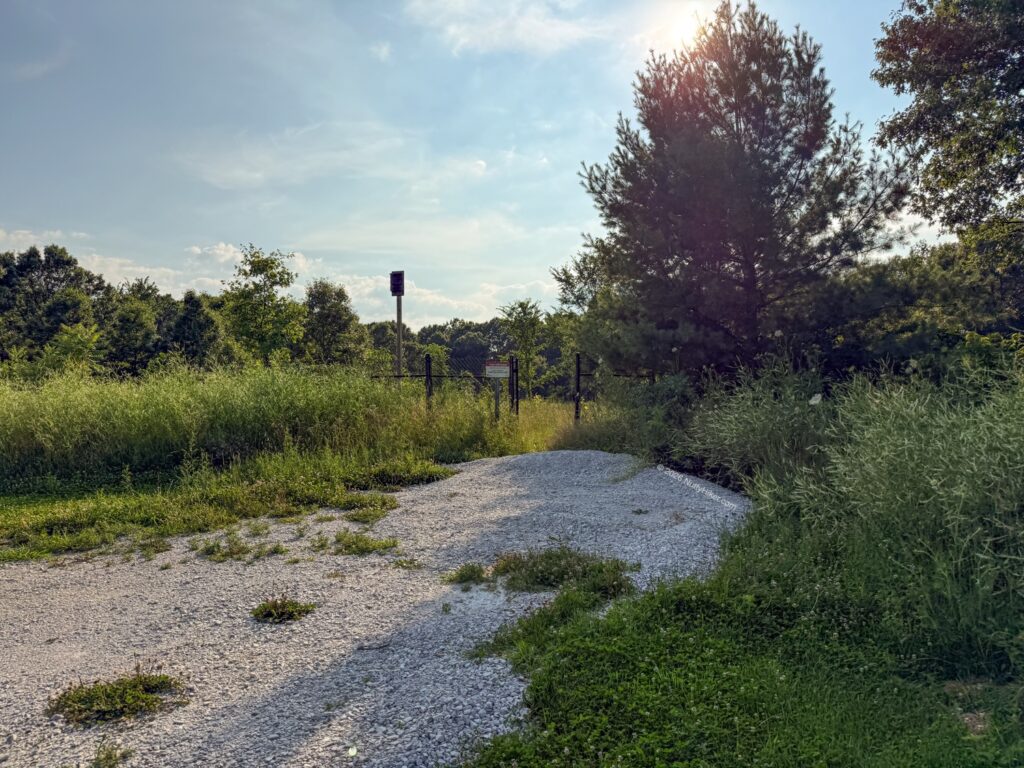
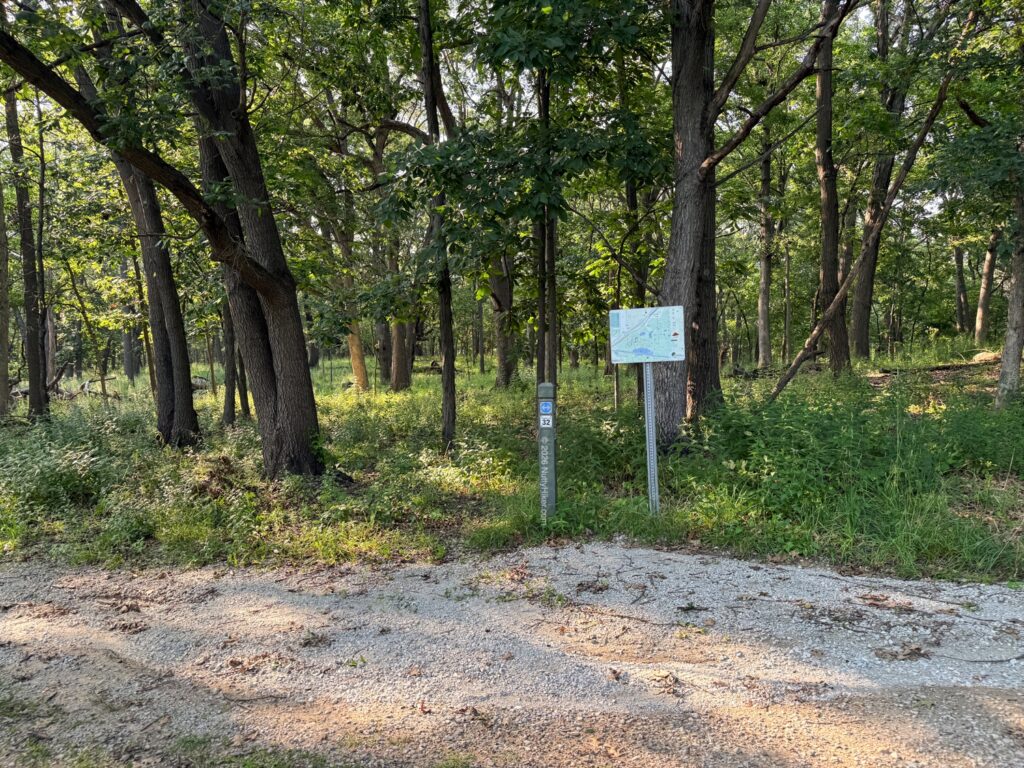
From there we went past the yellow trail to the next turn off to the right. You’ll notice a small trail (not marked on the map) that leads to a clearing. That is where you will find another burial site, which I believe is Plot M (you will learn about that below). There is a marker along with 4 other concrete pillars in the field marking the boundary of the burial location.
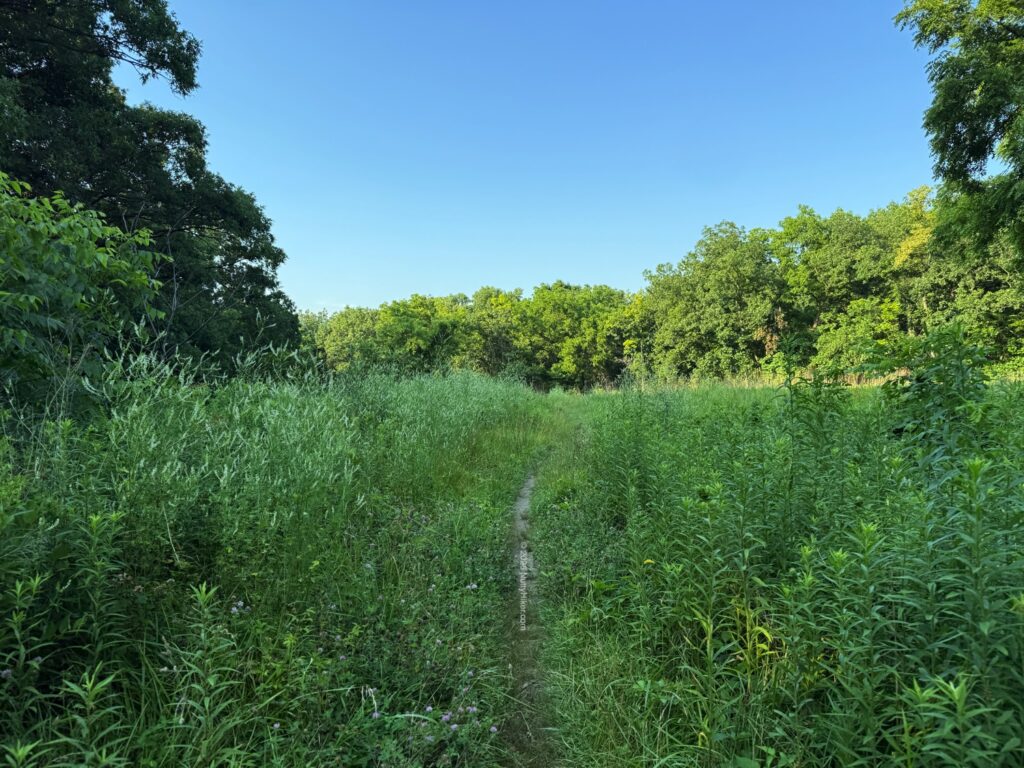
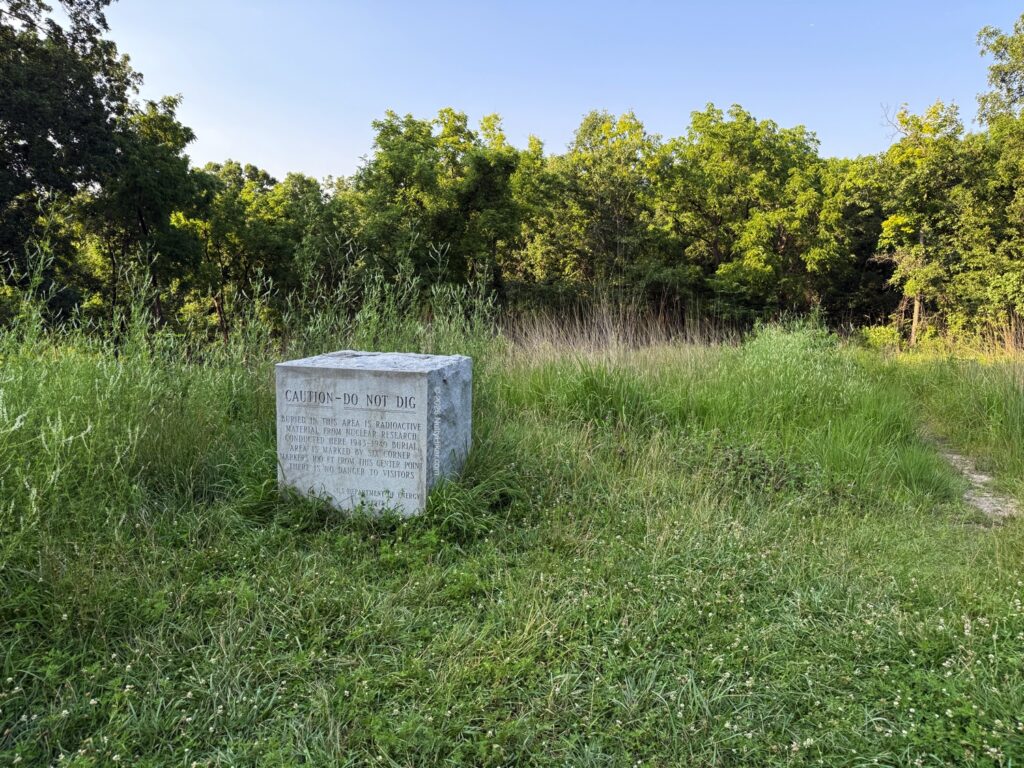
The marker reads “CAUTION—DO NOT DIG. Buried in this area is radioactive material from nuclear research conducted here 1943–1949. Burial area is marked by six corner markers 100 ft. from this center point. There is no danger to visitors. U.S. Department of Energy 1978.”
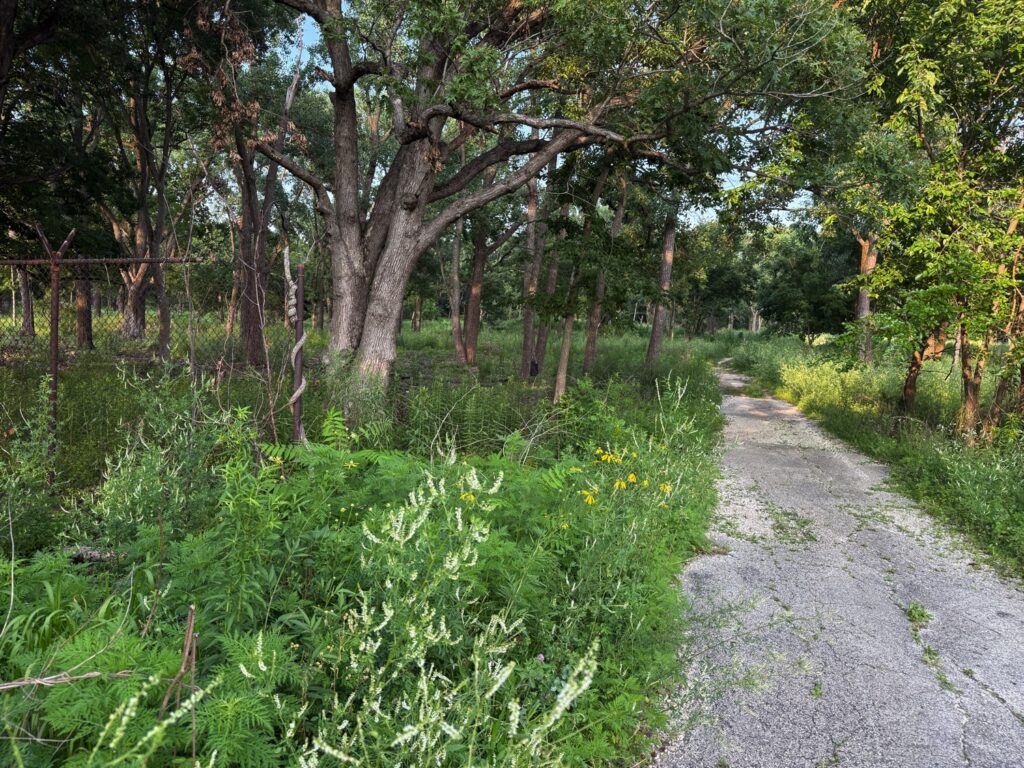
Once we found the markers, we turned around and headed back to the orange trail we had turned off of, then turned left and took our first right, which was the yellow trail. We followed that to where it dead-ended into the black trail and took a left on cracked and grown over pavement to Site A.
You will eventually come to an old rusty chain-link fence and an informational sign letting you know that you are entering Site A.
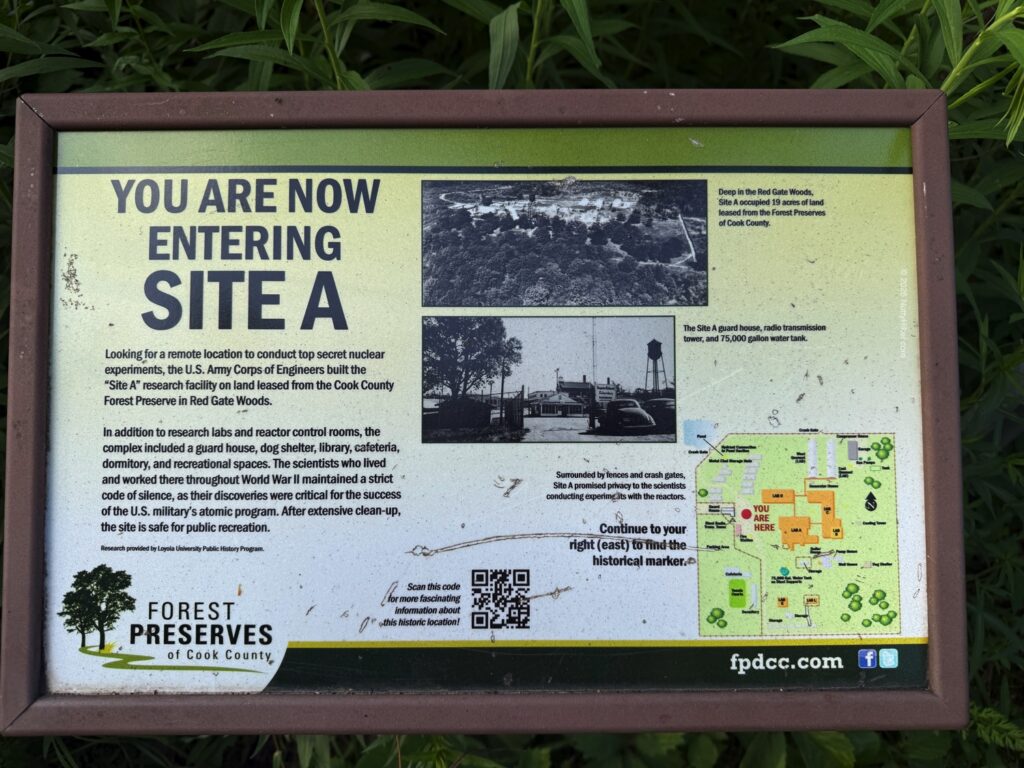
I love that the informational board also includes a map of where things used to sit. We were only interested in where the reactor was buried as we were running short on time, so we continued following the pavement until we came to the burial site.
The burial site has a marker and information board with pictures from when it was buried.
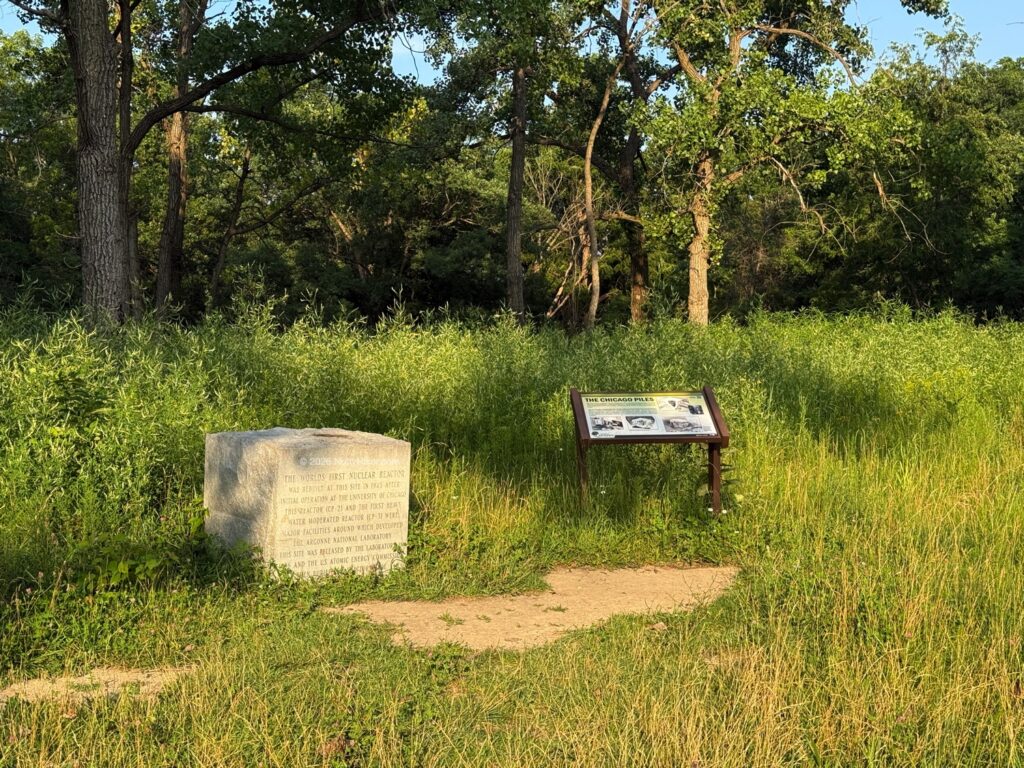
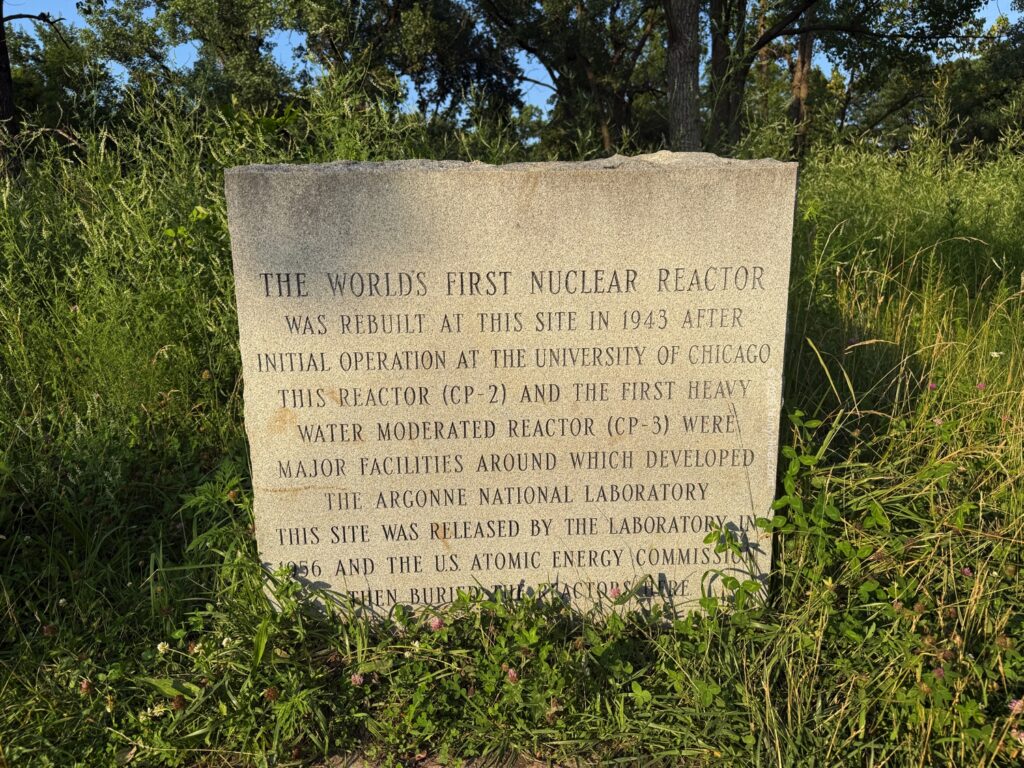
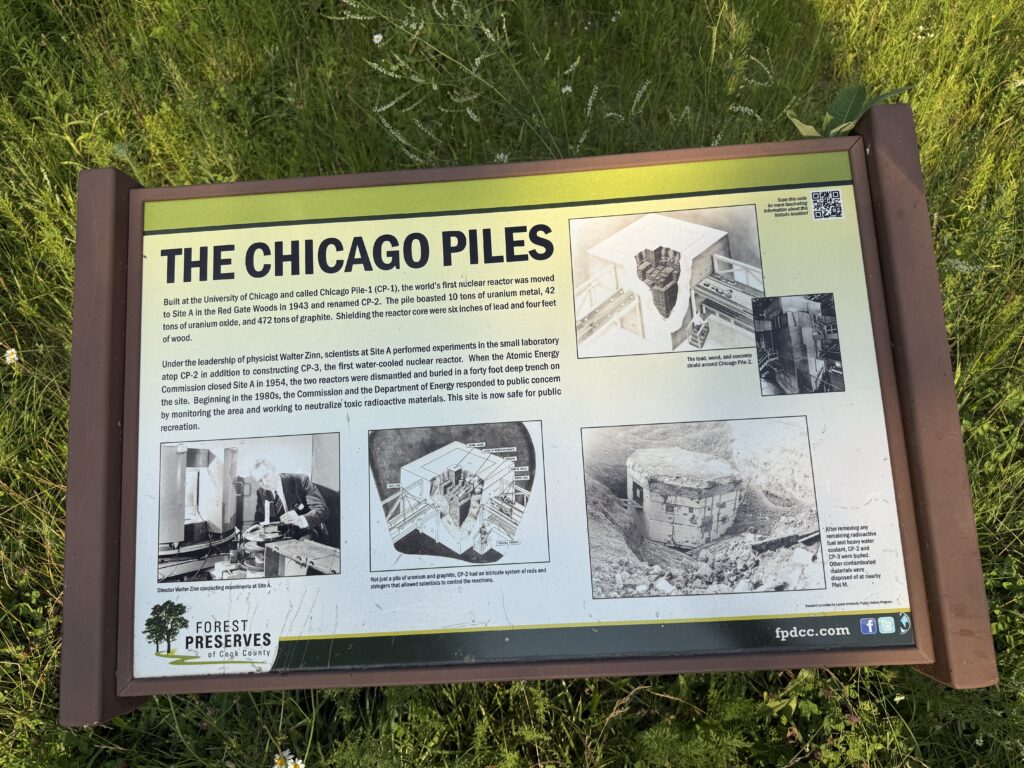
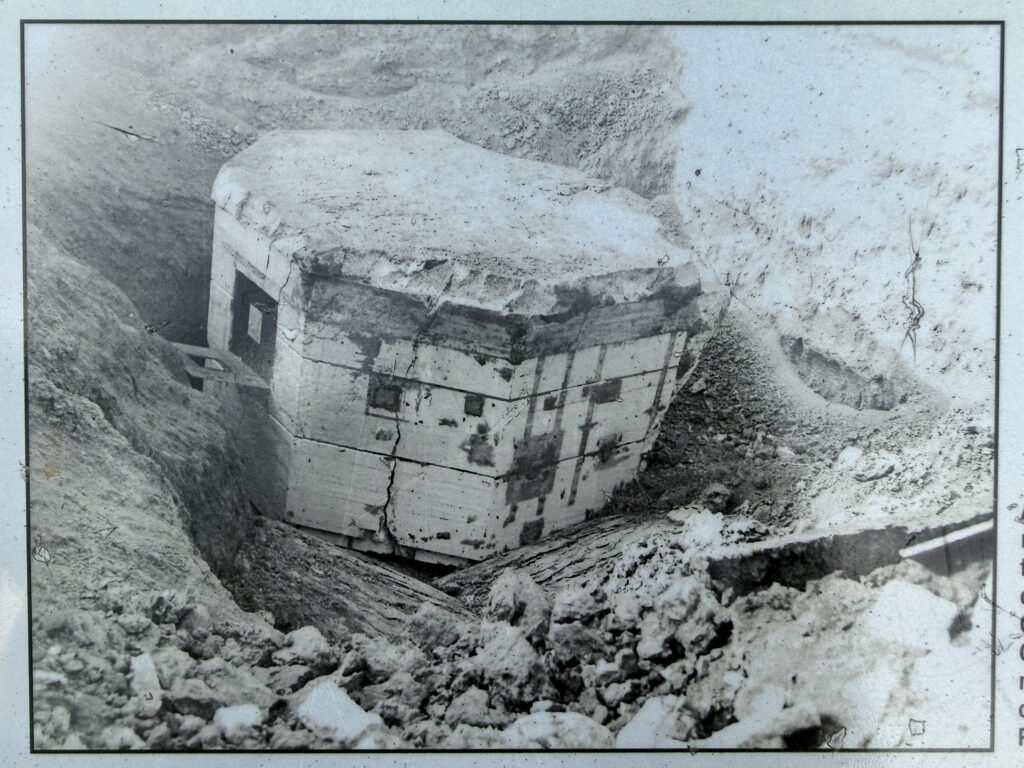
It was getting late, so we turned around to head back to the campsite. If you are wondering if I estimated correctly…it was just shy of 3 miles, and we spent 1.5 hours hiking and exploring!
The History of Site A and Chicago Pile-1
During World War II, this area became part of the top-secret Manhattan Project, the U.S. government’s effort to develop the atomic bomb. Known as Site A, the research facility played an important role in the early development of nuclear science and became the final resting place of reactors that helped usher in the Atomic Age.
The First Controlled Nuclear Chain Reaction
The story begins on December 2, 1942, at the University of Chicago, where physicist Enrico Fermi and his team of scientists achieved the world’s first controlled, self-sustaining nuclear chain reaction. Their experimental reactor, known as Chicago Pile-1 (CP-1), was constructed beneath the west stands of the university’s Stagg Field football stadium. This groundbreaking experiment demonstrated that scientists could control a nuclear chain reaction, marking a major milestone in the development of nuclear energy and atomic technology.
The experiment took place in a densely populated part of Chicago, however, and the university location was never intended to be a permanent home for the reactor. Scientists needed a more secluded location where they could continue their research with greater space and additional safety measures. That need led them to a wooded area southwest of the city that would become known as Site A.
From Chicago Pile-1 to Site A
In 1943, the original Chicago Pile-1 reactor was dismantled at the University of Chicago and transported to Site A in what is now Red Gate Woods. There, it was rebuilt with modifications and additional shielding, becoming Chicago Pile-2 (CP-2). The rebuilt reactor began operating in March 1943, allowing scientists to continue studying nuclear reactions away from the city.
Site A was more than just a place to house a reactor. The facility included laboratories, control rooms, living quarters, a cafeteria, and other buildings needed to support the scientists and staff working on classified wartime research. Security was tight, and the work carried out here contributed to the wider nuclear research program that eventually transformed the course of history.
Another reactor, Chicago Pile-3 (CP-3), also operated at Site A. It began operating in 1944 and was notable for being the world’s first heavy-water reactor. Together, the reactors helped scientists advance their understanding of nuclear physics and reactor technology during and after World War II.
Site A Today
Over the years, the former research area underwent environmental investigation and cleanup. The site was reopened for public recreation in 1991 following cleanup efforts, and monitoring of the former nuclear research and waste-disposal areas has continued. Visitors can now explore Red Gate Woods and learn about its scientific legacy while enjoying its wooded trails.
Why Were the Nuclear Reactors Buried at Red Gate Woods?
By the early 1950s, nuclear research was moving to newer facilities, and Site A’s days as an active research location were coming to an end. Operations ceased in 1954, and the reactors were decommissioned. Rather than preserve the reactor structures, the remaining reactor components and contaminated building materials were dismantled or buried at the site. Some materials associated with the research were also disposed of at the separate nearby location known as Plot M, which was the first place we visited.
What to Know Before Visiting Site A
If you’re planning to hike to Site A at Red Gate Woods to see where the world’s first nuclear reactor was buried, there are a few things to know before you go. Located in the Palos Preserves near Willow Springs, Illinois, Red Gate Woods offers a combination of wooded trails, natural scenery, and a connection to the history of nuclear science.
Trail Hours
Red Gate Woods and the surrounding Palos Trail System are open year-round from sunrise to sunset. Plan to arrive with enough daylight to find the Site A marker and make your way back to the parking lot before sunset.
Terrain and Trail Conditions
The trails at Red Gate Woods are primarily unpaved natural-surface trails that wind through oak woodlands, open areas, and forested ravines. The wider Palos Trail System features rolling hills and deeper ravines, so don’t expect every section to be flat or paved.
For this hike, I’d recommend wearing comfortable hiking shoes or trail runners with good traction. Natural-surface trails can become muddy, slippery, or uneven after rain, so check the weather and trail conditions before setting out. If you’re visiting during warmer months, expect shade in wooded sections, but don’t count on every stretch being fully shaded. It was hot and muggy when we visited in July.
Where to Park
The main entrance to Red Gate Woods is on South Archer Avenue, northeast of 107th Street, near Willow Springs, Illinois. Parking is available at the preserve, with access to the trail network from the parking area.
For navigation, use the official Red Gate Woods location and map. Once you arrive, check the trail map and any posted signs to help you locate Site A. The preserve connects to a much larger network of trails, so it’s worth knowing which direction you’re heading before you start walking.
Things to Watch Out For
Although this hike has a fascinating historical destination, remember that Red Gate Woods is a natural area rather than a developed historical attraction.
- Stay on established trails. The preserve has a network of unpaved paths, and it’s easy to take a wrong turn if you aren’t paying attention.
- Watch for mountain bikers. The Palos Trail System is shared by hikers and cyclists, so stay alert, particularly on narrower trails and around blind corners.
- Look out for ticks, insects, and poison ivy. These are common concerns when hiking in wooded areas, especially during warmer months. Consider using insect repellent and checking yourself for ticks after your hike. The mosquitos were absolutely horrendous when we hiked there in July.
- Be prepared for mud and uneven ground. Wear shoes with good traction, particularly after rainfall, and watch your footing around ravines and low-lying areas.
- Check for trail closures and restoration work. Habitat restoration has been underway at Red Gate Woods, so follow posted signs and respect any temporary closures.
- Respect the historical site. Site A is the burial location of former nuclear reactors. Stay in designated public areas, follow posted instructions, and never dig or disturb the ground.
Is Site A Safe to Visit?
It’s understandable to wonder about radiation when visiting the burial site of a nuclear reactor. According to the Forest Preserves of Cook County, the area underwent extensive cleanup before reopening for public recreation in 1991. The former research and disposal areas have also been subject to environmental monitoring.
Red Gate Woods is open to the public for recreation, but that doesn’t mean visitors should disturb the burial areas. Stick to the established trails and commemorative markers, and follow all posted guidance.
Just for fun, we had a Geiger counter with us, and it always fell within the lower normal range.
Facilities and Amenities
Red Gate Woods offers parking, trail access, and a picnic table. An accessible portable restroom is listed among the preserve’s amenities, but I didn’t see any sign of that looking on Google Street View.
How Much Time Should You Allow?
I’d set aside at least an hour or two to explore the trails and visit the historical markers, depending on your chosen route and how much time you want to spend learning about the site. If you’re interested in photography, birdwatching, or exploring more of the surrounding woods, you could easily spend longer.
During our Route 66 trip, we visited Red Gate Woods while camping at Camp Bullfrog Lake. A trail leads directly from the campground and connects to the main trail system, making it easy to access Site A without having to drive to another trailhead. Our round-trip hike was about three miles, and we spent roughly an hour and a half exploring the area.
Before heading out, check the official Red Gate Woods page for current hours, trail maps, and any closures or alerts.
Site A Hike Video
For me, it’s crazy to think how easy it would be to overlook this history if you didn’t know what happened here. During our Route 66 trip, had we not been camping at Camp Bullfrog Lake, I probably wouldn’t have researched the hiking trails that connect to it and therefore would have missed this easy hike to a place where a major turning point in modern science unfolded.
Sources & Further Reading
The following sources were used to research the history of Site A, Chicago Pile-1, and the trails at Red Gate Woods.
Forest Preserves of Cook County – Red Gate Woods — Official information on trail access, hours, parking, amenities, and the preserve’s natural features.
Forest Preserves of Cook County – “Site A” at Red Gate Woods & the World’s First Nuclear Reactor — Historical background on Site A, Chicago Pile-1, and the Manhattan Project.
Argonne National Laboratory – Early Exploration: Chicago Pile-2 — Historical details about the relocation of Chicago Pile-1 and its reconstruction as Chicago Pile-2.
U.S. Department of Energy – Site A/Plot M, Illinois, Decommissioned Reactor Site Fact Sheet — Information about reactor operations, decommissioning, buried materials, and environmental monitoring.
WTTW Chicago – Why Is the World’s First Nuclear Reactor Buried in a Forest Preserve? — Additional historical context about Site A, the Manhattan Project, and the site’s present-day significance.
This article is based on historical research and publicly available information. Trail conditions, access, and amenities may change, so check the official Forest Preserves of Cook County website before visiting.
Newpaper Clippings
Here is an old newspaper clippings for further reading.
 Site A Clean up – Southtown Star – Page 6 – Mar 13, 1994 Mar 13, 1994 Southtown Star (Tinley Park, Illinois) Newspapers.com
Popular posts:








Leave a Comment or Suggestion